
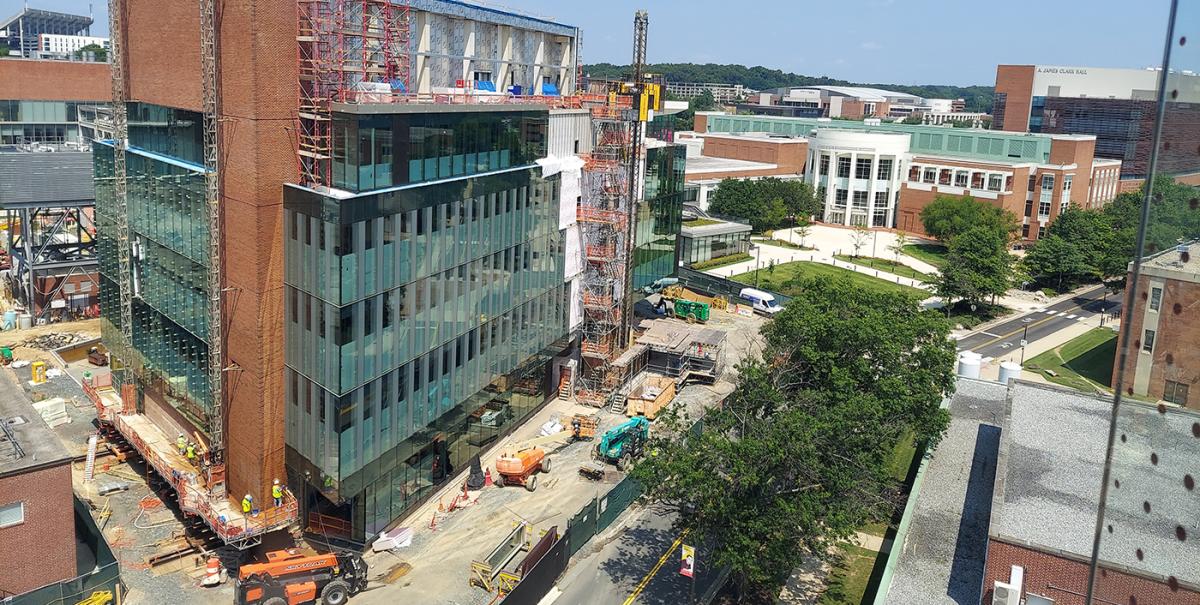
As Stanley R. Zupnik Hall moves steadily toward its 2026 opening, Facilities Management is already playing a key role in ensuring the building doesn’t just look impressive but also functions efficiently, sustainably, and reliably from day one.
Located at the heart of the Maryland Engineering complex, the 162,667-square-foot building will bring together research labs, faculty offices, student spaces, and one of the largest atriums on campus. But beneath those visible features is a complex network of systems that FM teams help plan, coordinate, and prepare to operate long before doors open.
Building Systems That Have to Work—Every Day
Construction of Zupnik Hall remains on schedule, with structural elements and envelope nearing completion and interior systems being installed in a carefully sequenced process from the lower levels up.
As work progresses, FM staff provide quality assurance by conducting inspections to verify that materials and installations meet campus standards and that contractor work aligns with approved designs and specifications. This phased approach allows FM staff to stay closely aligned with how critical building systems—mechanical, electrical, plumbing, lighting, and lab infrastructure—are integrated and tested.
Those systems aren’t just design features; they are the backbone of daily building operations.
FM’s involvement helps ensure that once the building is occupied, systems are accessible, maintainable, and ready to support highly specialized research environments.
Supporting a Net-Zero Future
Zupnik Hall is designed to be the university’s first operationally net-carbon-zero building. Achieving that goal depends not only on design, but on how the building is operated over time.
Heating and cooling will be supplied by the adjacent campus electric recovery and chiller plant, which also serves portions of the Chemistry Building. According to Bill Olen, Interim Associate Vice President & Chief Facilities Officer, Zupnik Hall represents a new standard for how campus buildings are designed and operated—one that depends on Facilities Management’s involvement to ensure building systems perform as intended over the long term.
Planning for What Comes Next
From commissioning and system testing to operations planning and staff training, FM teams are preparing now for the moment Zupnik Hall transitions from a construction site to an active campus building.
Exterior site work—including sidewalks, patios, and landscaping—will wrap up in 2026, but FM’s work continues well beyond construction milestones.
Because for a building like Zupnik Hall, success isn’t just measured at opening—it’s measured every day after.